
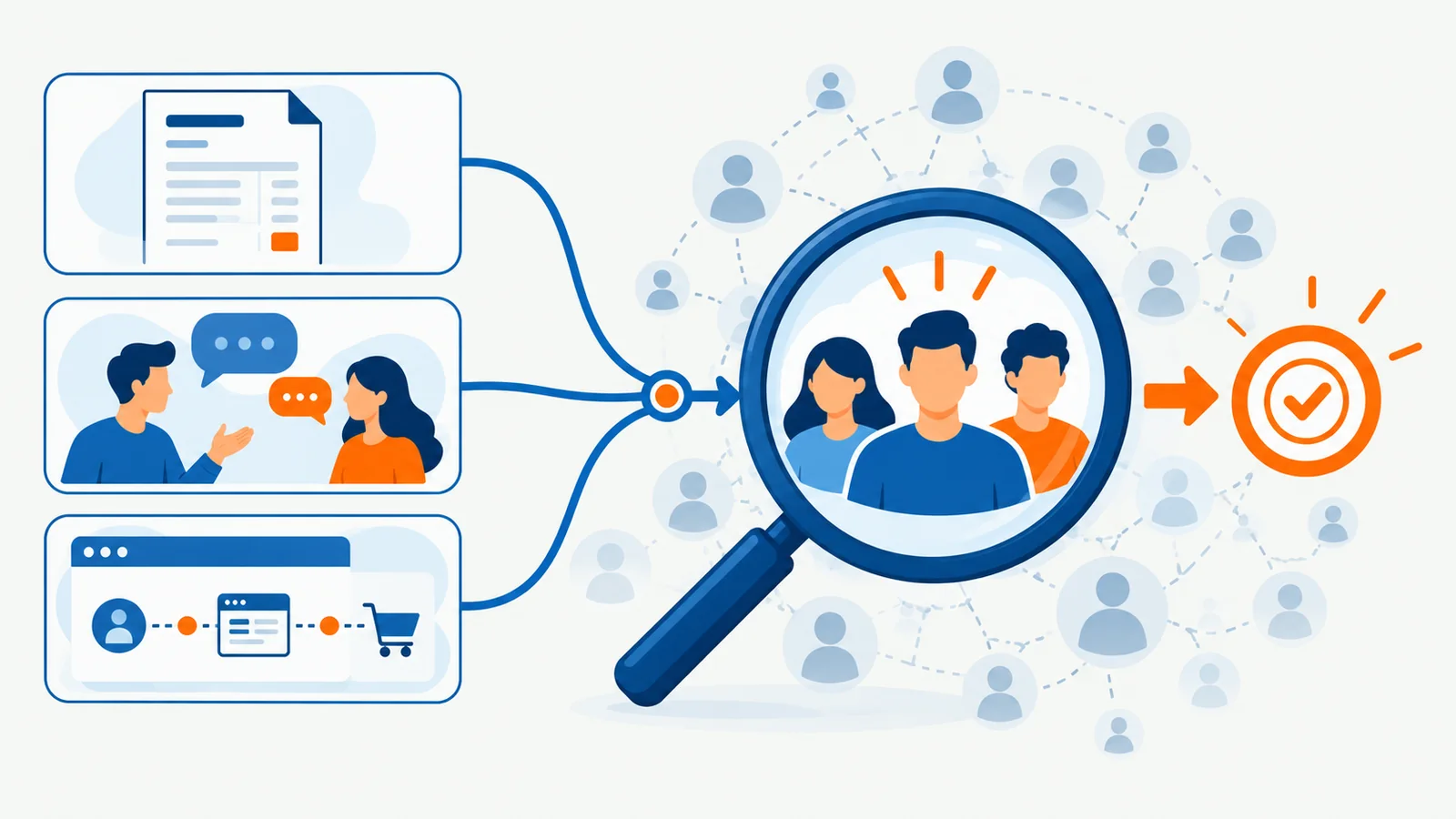
To identify your target audience using real data, examine who buys, why they buy, and what prevents other people from buying. Combine sales records, enquiries and customer interviews to find shared needs and buying situations. Then choose a segment you can serve effectively and test your message and route to market before expanding your spending.
“Our audience is aged 25–45 and values quality.” That description could apply to many people. It offers little guidance on what to say, why someone would choose you, or how to reach them.
Audience work often starts with an imagined customer and a search for evidence that supports the picture. A more useful starting question is: which customers have a clear need we can address, a reason to buy, and requirements we can meet with our available resources?
On this page
What is a target audience?
A target audience is a group you choose to prioritise with your offer, messaging and marketing effort because there is a reason your service fits their situation. That common ground may be a need, a stage of business development or an event that prompts a purchase, alongside factors such as location and budget.
A buyer persona summarises your understanding of a person involved in the purchase. Its usefulness comes from the evidence behind it. Giving an imaginary customer a name, age and hobbies does not replace understanding how they buy.
The buyer may also be different from the user. An employee might use a business service, a manager evaluate it, and an owner approve the budget. In the the loyalty platform case study, distinguishing the business owner who decides to subscribe from the consumer who uses loyalty points was central to shaping the message.
Start with evidence you already have
You do not need a complex research platform to begin. A simple working file can bring several sources together, provided you record where each observation came from and the period it covers:
- Sales and existing customers: who bought which service, whether they returned, and the time and cost required to serve them. Invoice value alone does not establish whether a customer is a good fit.
- Enquiries and sales opportunities: what people asked, why they contacted you now, and where conversations stopped. Record a lost opportunity’s reason when you know it, separating confirmed reasons from the team’s guesses.
- Support and returns: recurring expectations, difficulties and gaps between what customers understood and what was delivered.
- Website activity and acquisition sources: which pages and sources were associated with relevant enquiries or purchases, where tracking is reliable. Traffic volume alone does not explain buying intent.
- Customer interviews: conversations with buyers, people who chose an alternative and people who postponed the decision. Each group can reveal a different part of the picture.
Combining sources matters. The SBA’s market research guidance distinguishes existing market information from direct customer research; they help answer different kinds of questions.

Ask about something that happened
“Would you buy this service?” can produce a polite expression of interest. Instead, ask about the last time someone faced the problem:
- What happened that made you start looking for a solution?
- How were you dealing with the problem before that?
- Which alternatives did you consider, and how did you compare them?
- Who helped choose the solution or approve the cost?
- What could have stopped the decision, and what finally settled it?
Capture the customer’s language, getting permission if you record the conversation. Keep their words separate from your interpretation and remove personal details you do not need in the analysis file. A small set of interviews can help uncover patterns without representing the entire market.
The Australian government’s market research guide includes interviews, surveys and observing product use among research methods. Choose a method that fits the question you need to answer.
Turn observations into useful segments
Group cases around a pattern that affects the purchase. “Shop owners expanding their team who need a more organised customer follow-up process” describes a need and a situation. “Shop owners on Instagram” describes where they are present, but still leaves the buying need unexplained.
Write a short evidence card for each possible segment:
- Need: what problem or desired outcome do they describe?
- Buying situation: what makes addressing it a priority now?
- Decision: who uses, evaluates and pays for the service?
- Evidence: which records or conversations support the pattern, from which period? Are there cases that contradict it?
- Fit: can you serve this group with appropriate cost and effort?
- Unknowns: what still needs checking?
Separate observation from interpretation. “The customer asked about instalments” is an observation. “This whole segment buys on price” is a broader claim requiring more evidence. If all your records come from one acquisition channel, they describe the people that channel brought you, not necessarily the full potential market.
An illustrative example: one service, two needs
This is a hypothetical example, not a client project or reported business result. Imagine a small product photography company. Its enquiry records suggest two groups: new businesses needing a limited set of launch images, and established shops regularly adding products that need consistent images and predictable delivery.
The company should not choose the second group solely because repeat work sounds attractive. It first needs to check whether it can support regular deadlines, deliver at an appropriate cost, and establish that those shops value consistency and coordination enough to pay for them.
If records and interviews support the choice, the company could test an offer for product batches with a defined delivery schedule. Its message could explain the process and show relevant image samples. It would then assess enquiry quality, bookings and delivery effort against a documented baseline. This tests a hypothesis; the findings may change the choice.
Choose a priority and test how to reach it
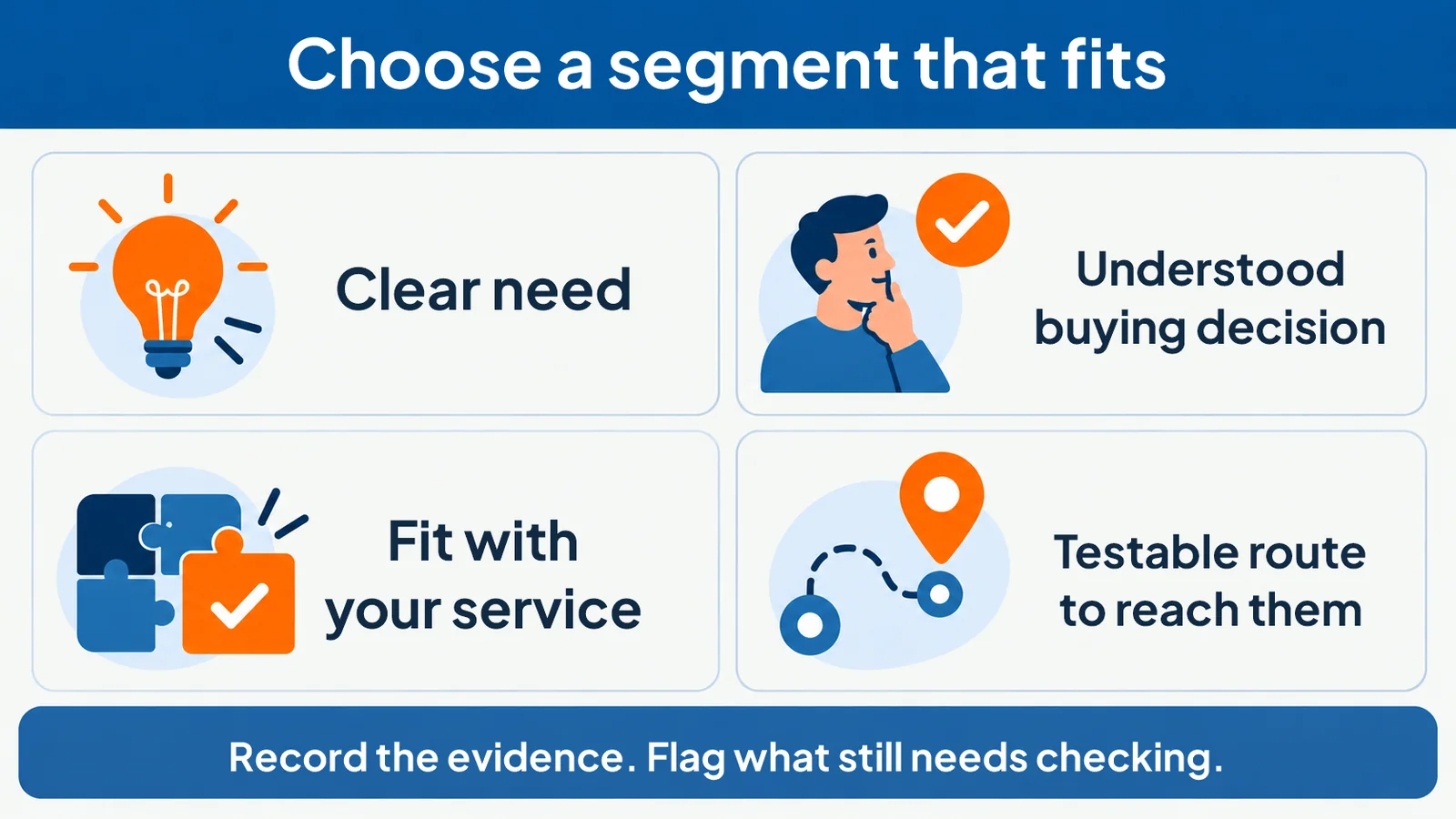
Compare segments on four considerations: clarity of need, understanding of the buying decision, fit with your service, and a feasible route to reach them. Record the reasoning and supporting evidence. Avoid precise scores that imply certainty you do not have.
Then write one working hypothesis: “We will start with [segment] because they face [problem] when [situation]. We have [evidence] that our offer fits. We will test [channel] and assess [business-relevant outcome].”
Choose a limited test you can support: an offer page, appropriate direct outreach, or content addressing a repeated objection. Define a qualified enquiry before the test—for example, a need within your service scope, workable timing and involvement of the appropriate decision-maker. Evaluate sales or meaningful steps towards them alongside cost and delivery capacity.
If the audience review comes before a spending increase, also read how to review your marketing before increasing your budget to consider measurement and the customer journey alongside segment selection.
What can the data not tell you on its own?
Likes do not establish willingness to buy, and existing customers are not the whole market. In Google Analytics, distinguish users, sessions and events; GA4 user definitions vary by metric. Clicking a contact link also does not confirm that a conversation or sale took place.
Do not turn a report entry into an identified person or a story about their intentions. Check tracking quality, separate test visits where possible, and keep conclusions proportionate to the evidence. If you use an AI tool to organise notes, work with de-identified material and review its summary. Do not use it to invent interviews or present filled-in gaps as facts.
Common questions before you start
How do I identify an audience without existing customers?
Start with hypotheses based on the problem you address, alternatives people already use, and conversations with potential buyers. Test a small offer before making a large investment. Label evidence and assumptions separately; having no sales history is not a reason to invent data.
Should I target only one segment?
You can serve several. With limited resources, choosing a priority helps you develop and assess a relevant message and offer. Treat segments separately when their reasons for buying, decision-makers or routes to market differ materially.
How often should I review the audience definition?
Review it when you accumulate new evidence, change the offer or price, face market changes, or see a sustained difference in customer quality. There is no single interval for every business, and a short-term fluctuation does not automatically justify a new direction.
Start with a choice you can explain
Before writing a detailed ideal customer profile, bring together your records and your team’s observations. Identify a pattern worth testing. Be able to explain why you chose it, what supports the choice and what could cause you to reconsider.
Audience selection is part of building a small business marketing strategy, connecting customer value, messaging, channels and measurement. If you need to bring those choices together for your business, book a meeting to discuss your marketing needs.