

Case Study

In heavy equipment marketing, buyers need to understand the machine and feel confident about what happens after the purchase. Are spare parts available? Will the supplier respond quickly when maintenance is needed? Those concerns were central to a project I worked on as part of the marketing team for a heavy-equipment and power-generation company.
We started with a new page and no followers. We also had real work to draw on: equipment deliveries, engineers travelling to customers and maintenance in the field. We combined that material with footage from the equipment manufacturer to introduce the products and bring the business closer to its audience.
On this page
An established business with a new page
The company sells heavy equipment, power generators and excavators in an African market. Its commercial operation was established, but the page we took over was new and had no follower base.
We needed to explain the equipment’s uses and features while giving after-sales service a prominent place in the content. Buyers needed confidence in spare-parts availability and the company’s responsiveness when they needed support.
Footage from the maintenance team gave us a practical way to address that concern. We could show the team’s everyday work rather than relying entirely on statements about the service.
My role: connecting content direction with everyday execution
I was part of the marketing team developing the company’s digital presence. My contribution included developing and guiding the content and digital marketing strategy, planning topics, reviewing messages and technical information, and coordinating content, design and video work with the team.
I reviewed the material against what we wanted to communicate: how could we explain the product clearly? Which parts of the company’s work deserved more attention? How could we give after-sales service a presence that reflected its importance to buyers? Following performance helped us see what the audience responded to and refine the work.
Two content sources: manufacturer footage and the maintenance team
We relied on two main sources of video, each serving a different purpose.
Manufacturer footage to explain the equipment
We obtained existing videos from the equipment manufacturer and re-edited them with a different montage to suit the company and its product presentation.
This let us use available material instead of taking on the cost of commissioning a videographer to film everything from scratch. In planning and reviewing the content, I focused on the information each video needed to communicate and how the edit could support it.
Maintenance footage to bring the service closer to the audience
The maintenance engineers sent us ordinary field clips, usually without spoken commentary: equipment being delivered, journeys to customer maintenance visits and work taking place on site.
We often published those clips as received. Their simplicity was part of their value. People could see real work and the team in the field, making this material particularly relevant to how we presented after-sales service and customer support.
Technical footage from the manufacturer and everyday clips from the engineers gave us different ways to present the products and service. Choosing the right angle depended on understanding the audience and the questions that mattered to them.
Coordinating content across platforms
We worked across Facebook, Instagram, TikTok, LinkedIn and YouTube. Having the material was the starting point. We then decided how to use it on each platform and coordinated messaging, design, video and publishing. The results we achieved during these periods were entirely organic, with no paid advertising.
Field content and patriotic music became an important part of our TikTok approach. On LinkedIn, we gave more attention to company achievements and participation in events. The business was the same, but the story and emphasis varied by platform.
This is a practical connection between marketing strategy and a marketing plan: understand what to communicate and to whom, then organise the work that will deliver it.
A website for a branch in a different African market
In another part of the engagement, we worked on a website for the company’s new branch in a different African market. My contribution covered the site structure and content, and coordination of its implementation using WordPress.
Meta: more than half a million organic views in five months
In the first five months of 2026, we generated 506,983 organic views and approximately 11.1K content interactions on Meta. Within those five months, we had exceeded the total views achieved across the whole of 2025.

For April–June 2026, the content generated 295.1K views and 6.6K content interactions, also entirely organic.

TikTok: field content and patriotic music connected with the audience
When we began sharing field content on TikTok, we saw performance improve. We paired some edited videos with patriotic songs and used patriotic music with images too. This approach brought the content closer to the audience and encouraged engagement.
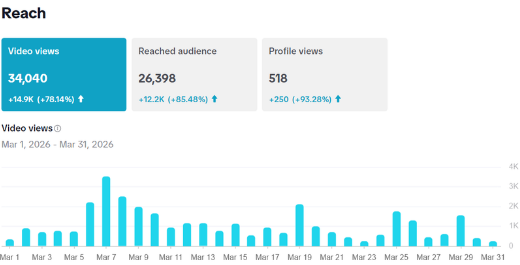
In March 2026, we recorded 34,040 video views, a reached audience of 26,398 and 518 profile views. Video views rose 78.14% compared with the previous month, while likes reached 902, an increase of 42.5%.

LinkedIn: the exhibition and company achievements gave us a different story
The company participated in an exhibition, and using the event’s hashtag increased exposure for the posts. We also began publishing more about company achievements instead of relying mainly on product specifications and features.
That gave us more opportunities to show what the company was doing and participating in, and increased audience engagement with the content.
From April to the beginning of July 2026, we generated 15,508 impressions, up 104.3% against the previous period. The LinkedIn account reached 350 total followers.


What I took from the project: start with the real work and the buyer’s questions
This project reinforced the importance of choosing the right material in a specialised market. A manufacturer’s video can help explain the equipment. A simple clip from a maintenance engineer can bring after-sales service closer to the audience. An exhibition can provide a fresh angle for the company’s story.
My role was to connect those materials with the content direction: what should we highlight, how should we present it and on which platform? The results helped us understand the audience’s response and review our choices over time.
For me, that was the most useful part of the work: making good use of the resources already available to create clear, relatable content that supported understanding of the products and confidence in the company.
If you have a specialised business and need to organise its content and presentation, tell me about your project, and we can discuss the messages and resources you have to work with.