
A marketing team can use AI to double the number of drafts while still struggling with the same questions: who are we addressing, and what do they need to understand? More production can simply increase review time when the underlying bottleneck remains unclear.
I prefer to start with the task that needs improvement: slow research, repeated customer questions, unclear messaging or manually assembled reports. Then I decide how an assistant might help and how its output will be checked.
AI in marketing can support research organisation, content development, visual concepts and analysis of suitable data. Useful adoption requires a defined objective, reliable inputs, review responsibilities and measurement connected to the task and business outcome.
On this page
Start with the decision
Identify the decision you need to support. Which questions should a service page answer? Why do visitors reach a page but stop before the next step? The decision determines the evidence and task.
Use the distinction between marketing strategy and a marketing plan to establish direction. Production tools do not replace the business information required to set priorities.
Applications across the workflow
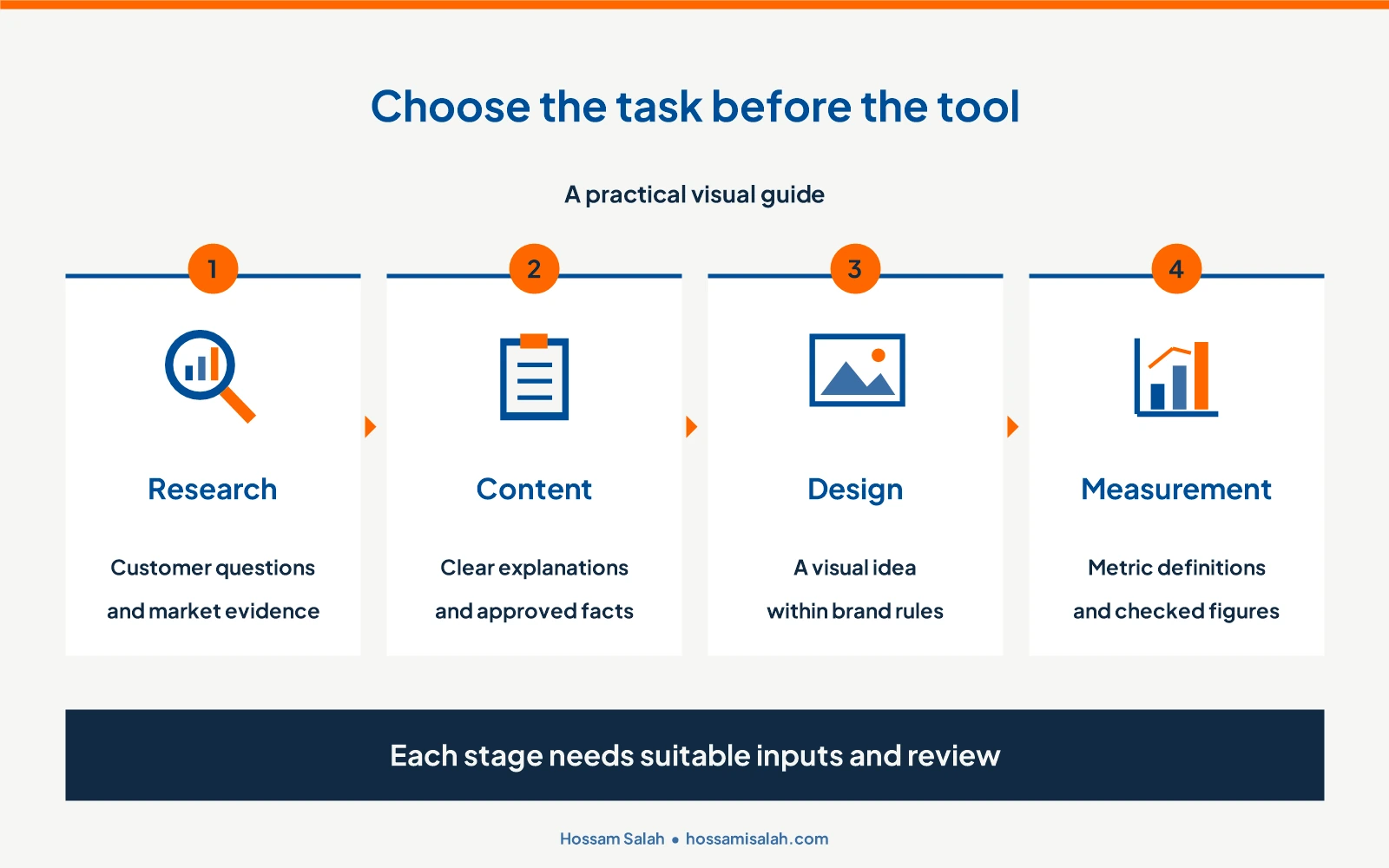
| Stage | A starting task | Inputs | Review |
|---|---|---|---|
| Research | Group customer questions and observations | Material appropriate to share | Meaning, categories and unsupported counts |
| Content | Develop ways to explain a problem | Approved service facts and audience | Usefulness and promises |
| Design | Develop a visual concept | A brief and brand rules | Product, typography and composition |
| Measurement | Summarise a report and propose questions | Reliable data and metric definitions | Period, measures and calculations |
1. Organise research and questions
Collect repeated questions and team observations after removing information unnecessary to share. Request topic groups while retaining the original wording or a reference for each observation.
After checking the groups, identify gaps. Does the material represent only buyers? Do you have objections from people who did not purchase? An assistant can organise the evidence, while sample quality remains central to market research.
2. Explain before asking for a sale
Choose one question and establish what the customer needs to understand. Use an assistant to suggest an outline or examples, then supply the business facts and edit the wording.
A maintenance service might need to explain response steps and spare-parts availability rather than repeat “best service”. Actual detail makes the content more useful and supports consistent sales conversations.
The AI writing guide and content strategy guide develop this workflow.
3. Produce visuals within a clear system
Translate the idea into a visual brief: message, subject, format and space for copy. Generate an appropriate component, review it and finish the typography and brand treatment.
Preserve the details of a real product rather than accepting a broad resemblance. Keep approved rules and assets so that each design does not begin from scratch. See the image and video guides for practical steps.
4. Summarise performance and identify questions
Supply a table with dates and metric definitions, then state the comparison needed. Ask for changes, checkable calculations and questions requiring additional evidence.
If page visits increase while bookings do not, investigate traffic sources, booking-event definitions and page behaviour. Two numbers cannot establish a single cause.
Separate opening a calendar from a confirmed booking, and distinguish internal testing from visitors where the data allows. Metric definitions determine a report’s meaning before the wording is polished.
An illustrative service-page workflow
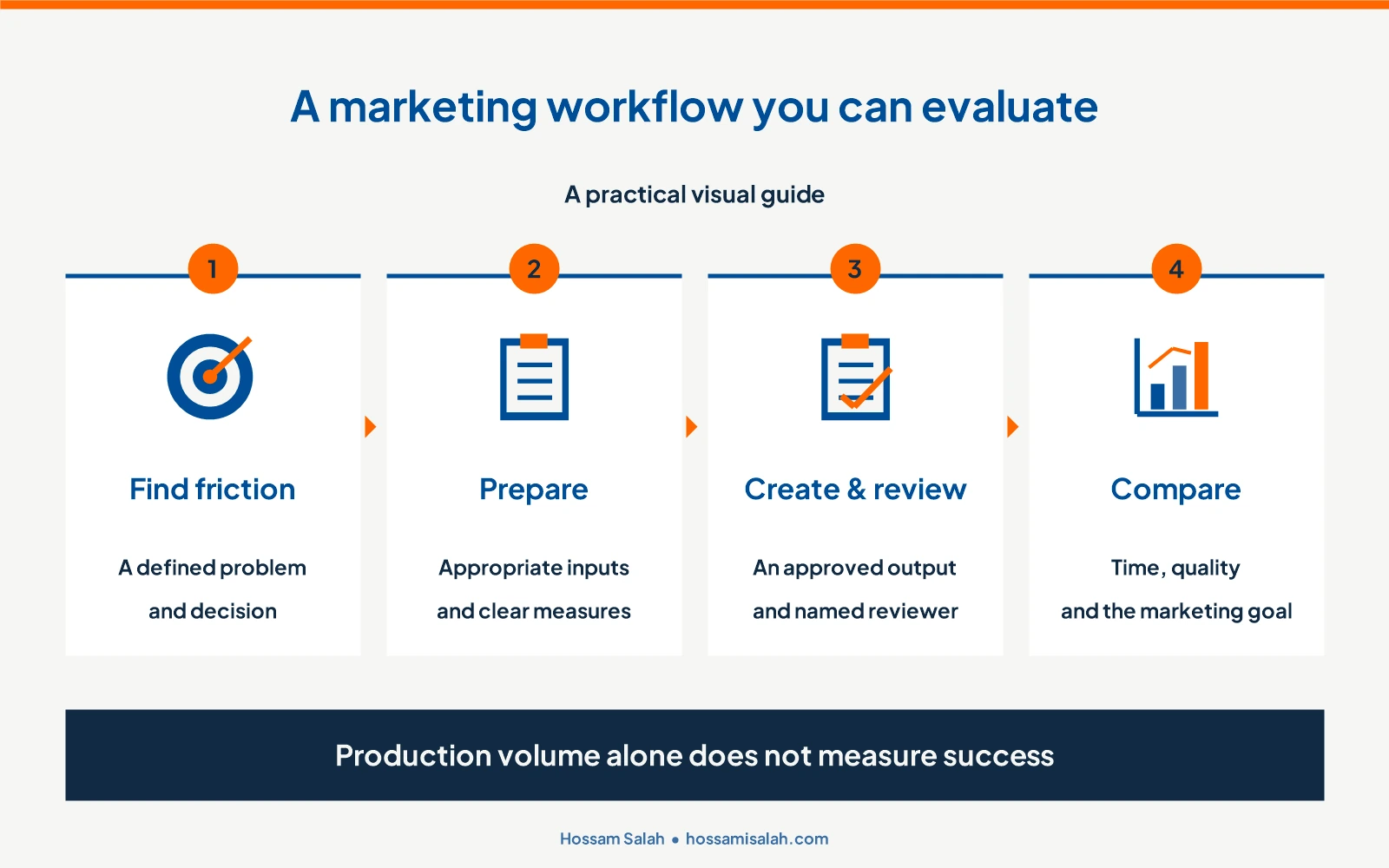
Imagine a team receiving repeated questions about a service while visitors reach the page but do not continue. The team groups the questions and identifies two objections that need clearer answers.
An assistant helps organise wording about scope and the next step. The service owner reviews it, the team updates the page and measurement tracks relevant behaviour over a suitable period.
If results improve, examine other changes before assigning all improvement to the copy. This example explains a workflow; actual outcomes require the business’s evidence.
Measure the value of adoption
At production level, track total time, correction effort, errors and repeatable quality. At marketing level, use the outcome connected to the goal: a qualified enquiry, confirmed booking or purchase.
Record a baseline and compare similar tasks. Include preparation and review time rather than generation alone. More drafts do not establish more sales.
Set data and review responsibilities
Define who can share material and approve results, using only the data required. Remove irrelevant personal details and review the provider’s policies and account settings.
Maintain an approval point before publishing a message, changing an offer or sending a customer response. Fast production should not introduce unapproved promises.
Frequently asked questions
Which tool should I start with?
Define the task, inputs and output, then use the tool selection guide. Different marketing stages may need different capabilities.
Can AI replace audience understanding?
It can organise information and suggest questions, but useful conclusions still need appropriate evidence from the business and market.
Can it make budget decisions?
Use it to organise calculations and scenarios, then check assumptions and measurement. A real budget decision needs a complete view of objectives, costs and outcomes.
Choose one measurable task
Write down the problem, available information, acceptance criteria and reviewer. Try a small workflow and compare time, quality and results before expanding it.