
You have a content calendar for the month, campaign dates, an allocated budget, and a team that knows what to deliver.
But ask why you are targeting those customers, why you chose those channels, or why someone should choose your business, and the answers are still unclear.
The work may be organised while the choices behind it need more thought. Adding more posts or campaigns will not resolve those choices on its own.
That is why the difference between a marketing strategy and a marketing plan matters. The point is to identify what your business actually needs, rather than simply use the terms correctly in a meeting.
What is the difference between a marketing strategy and a marketing plan?
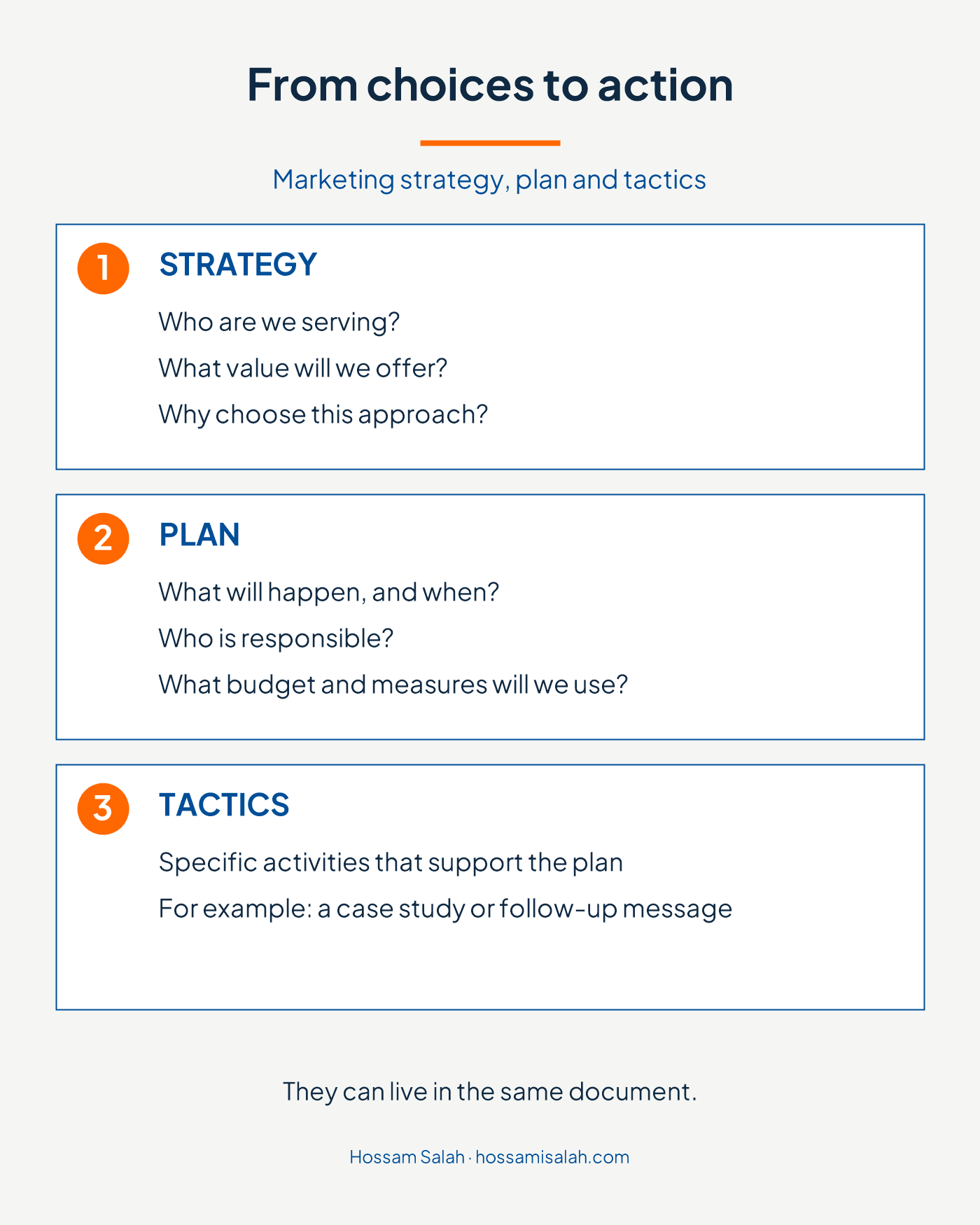
A marketing strategy sets out your choices: which customers to focus on, the value you will offer, how you will stand apart from alternatives, and why that approach fits your goals and resources.
A marketing plan turns those choices into connected activities: what will happen, when, who is responsible, what resources it requires, and how progress will be reviewed.
This distinction is consistent with the American Marketing Association’s explanation of strategy and planning. It does not require two separate files. Both can sit in one document.
| Comparison | Strategy | Plan |
|---|---|---|
| Main question | What will we choose, and why? | How will we turn that choice into work? |
| Focus | Customers, value, positioning and priorities | Activities, ownership, timing and resources |
| Example decision | Focus on a segment whose needs we can serve well | Prepare relevant evidence and contact suitable businesses in that segment |
| Possible reason to review | An assumption about the customer or market proves inaccurate | Delays, costs or results call for changes to activities |
Time horizon alone does not explain the difference. A plan can cover a year. A strategic choice may need reviewing much sooner if new evidence changes your understanding of the market.
Where do tactics fit?
Tactics are specific activities used in execution, such as preparing a case study, sending a follow-up message, or holding an introductory session.
“We will use LinkedIn” does not explain a complete strategy. Who are you trying to reach there? Why are they on the platform? What will you offer them, and how will that contact support a business goal?
The same channel can support different goals. An activity that suits one business may be a poor use of another business’s time, depending on its audience, stage and resources.
A practical example: one goal does not make every activity suitable
The following example is hypothetical. It is not a client case or a result from my work.
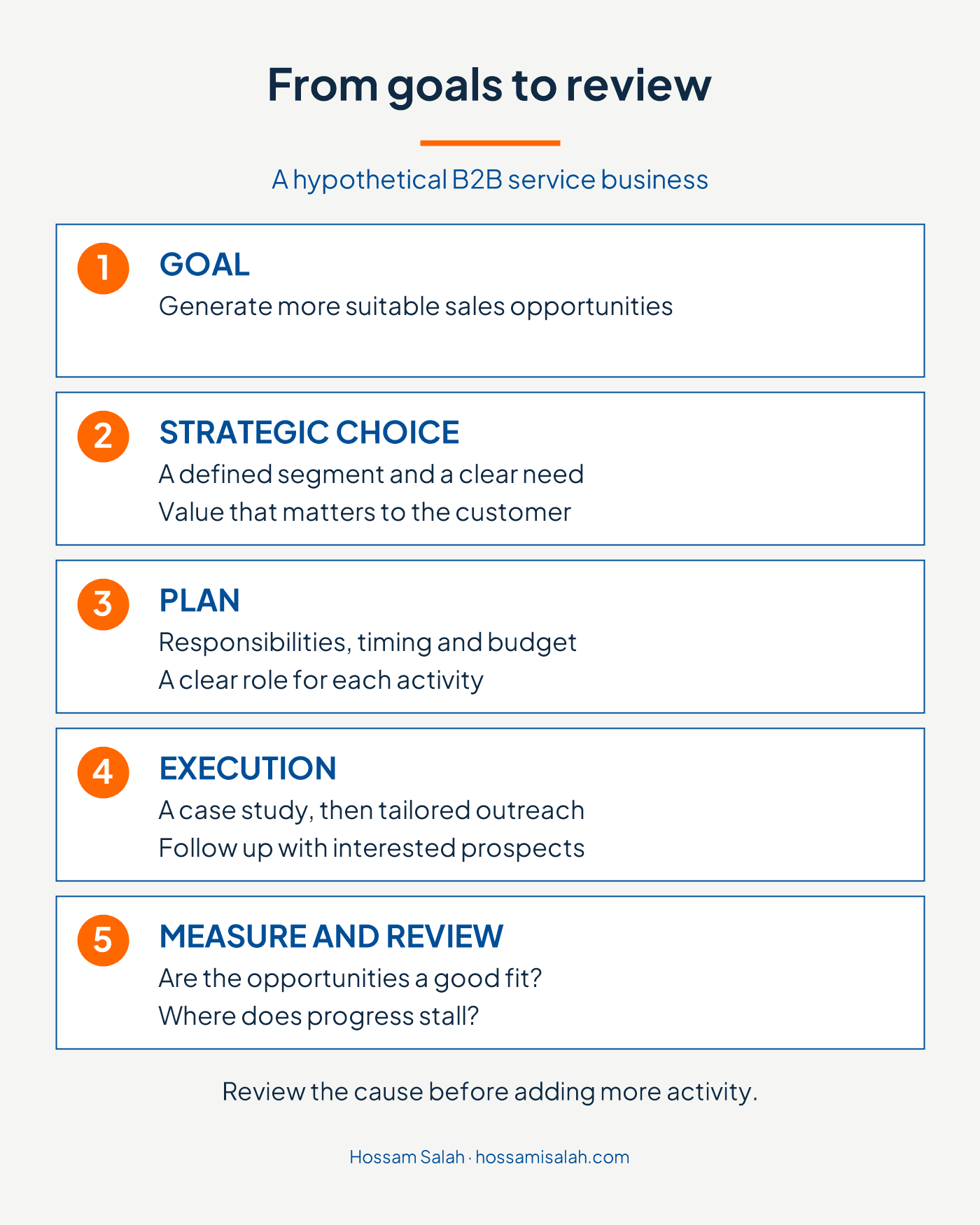
Suppose a B2B service company wants more suitable sales opportunities. Its team is small and its time is limited. It could post daily, advertise, attend events or contact prospects directly.
Before assigning tasks, imagine it reviews customer enquiries and its own delivery capabilities. It identifies a clear need in one segment and decides to test a focused approach, rather than send the same message to every kind of business.
The strategic choice
The company focuses on a defined type of customer, a need it can serve, and value it can explain and support with evidence. It chooses a way to reach decision-makers based on their behaviour and the team’s ability to follow through.
Defining an audience involves more than age or location. Needs, buying behaviour, willingness and ability to pay also matter. The business.gov.au guide to identifying a target market explains why assumptions should be tested through research rather than treated as established facts.
The plan
The company assigns someone to prepare a genuine case study that can be shared, sets a deadline, decides who will select suitable prospects, and outlines tailored outreach and follow-up for interested people. It checks the time and cost involved before committing to activity it cannot sustain.
The case study, outreach message and follow-up are activities within the plan. The reasons for choosing that segment and offering that value are part of the strategic thinking guiding them.
Measurement tests assumptions and execution
Replies and conversations may be useful early indicators. But a reply is not automatically a suitable opportunity. The company needs a working definition: a relevant need, a business it can serve, and a meaningful next step.
If many replies describe needs outside the service’s scope, review the audience and message. If relevant prospects are interested but follow-ups are late, examine execution. If opportunities fit but agreements stall, investigate why before blaming the channel.
These indicators help frame the next question; they do not establish the cause by themselves. More than one issue may be involved.
Do you need clearer direction or better execution?
If you change channels every month because results disappoint, yet cannot explain why you chose them in the first place, start by reviewing the choice. If your message is trying to appeal to everyone, consider whose needs your service actually fits and what matters to them.
If the customer and value are clear but tasks slip, responsibilities overlap, and there is no budget or review date, a substantial part of the problem may be planning and managing execution.
This is a starting point for diagnosis, not a precise test. Weak choices can make execution difficult. Weak execution can also lead you to reject a suitable approach before it has been tested properly.
Establish what actually happened, what remains on paper, and which assumptions the evidence supports or calls into question.
Does a small business need two separate documents?
Not necessarily. A short, clear document can be enough to start, provided it explains the choices and how they will be carried out, and is reviewed as new information appears.
The business.gov.au marketing plan guide includes market understanding, positioning and goals alongside activities, timing and budget. The document’s name does not determine the quality of the thinking inside it.
Documentation may need to grow with complexity: more markets, a larger team, greater commitments, or more people who need to agree. A lengthy file has little value if it does not help someone make a decision or do their work.
Before adding more activity, answer these questions
- Which business goal should marketing contribute to?
- Which customers will we focus on, and what evidence suggests a relevant need?
- Why should they choose us over alternatives, and what supports that value?
- Why do the activities fit our goals and resources? What will we postpone?
- Who owns each activity, when will it happen, and what will it cost?
- What will we measure, when will we review it, and what evidence could change our decision?
If the first answers are unclear, filling next month’s calendar will not resolve them. If the choices are clear but nobody owns delivery, rewriting the strategy alone will not move the work forward.
Identify what needs fixing before deciding what to do next. The useful step might be removing an activity, improving follow-up or reviewing an audience, rather than adding another campaign.
