

Competitor analysis becomes useful when it helps you make a decision about your audience, offer or message. Start with a specific question, compare the alternatives buyers actually consider, and record the source and date of each observation. Then turn the findings into a hypothesis and a test, rather than treating a competitor’s visible activity as proof of success.
You can spend hours collecting competitors’ prices and follower counts and finish with an impressive document. Yet when it is time to choose a campaign message or adjust your offer, the document may leave you with the same unanswered questions.
The starting question often explains the gap. “What are our competitors doing?” is broad. “What must we explain so buyers can compare our offer with alternatives?” gives the research a practical purpose.
On this page
Define the decision before collecting information
Competitor analysis is a structured review of alternatives competing for a customer’s needs, budget and time. It helps you understand your position and choose how to compete. You do not need to know everything about every business.
Start with one decision. Do you need to clarify service scope? Explain a price difference? Reconsider a segment or a route to reach it? The question determines which information is worth collecting.
If buyers are comparing offers with different deliverables as though they were equivalent, prioritise scope, exclusions, delivery arrangements and supporting evidence. Weekly posting frequency may contribute little to that particular decision.
Sometimes the question runs the other way: is pricing close to competitors making the service difference less clear? In a project I contributed to for the beauty centre, a beauty centre, higher-cost materials were used while prices remained close to alternatives using different materials. Some customers began questioning the difference, prompting a review of pricing and how the service’s value was explained together. The the beauty centre case study shows how comparison raised a question about consistency across the offer, price and message, rather than simply who was cheaper.
Who is a competitor from the buyer’s perspective?
Start with alternatives mentioned in sales conversations. Ask, “How else were you considering solving this?” The answer may expand the comparison beyond businesses you already follow.
- Direct competitors: similar solutions for the same segment in comparable buying circumstances.
- Indirect alternatives: a different way to address the same need, such as an off-the-shelf tool instead of a tailored service.
- Internal solutions or postponement: using an existing team, continuing with the current process or delaying the expenditure.
The SBA’s market and competitive analysis guidance includes indirect and secondary competitors. Customer needs, rather than matching service names alone, define the comparison.
Choose a manageable group you can examine in depth, including alternatives that recur in actual buying decisions. There is no fixed number for every business. The largest brand may be less relevant than a local provider serving your specific segment.
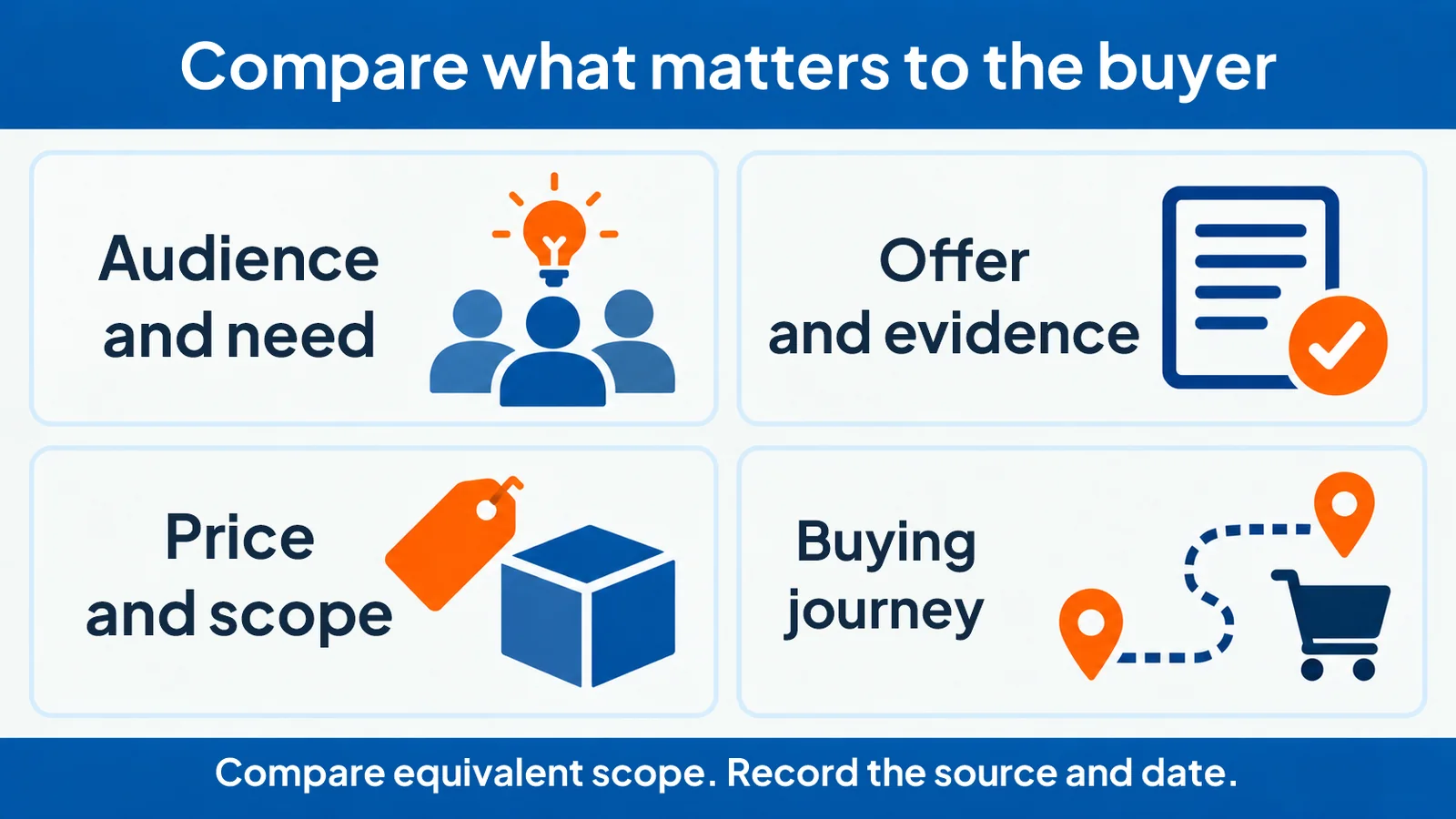
Compare factors that affect the purchase
Use consistent questions for each alternative. Leave room for “not available” rather than filling gaps with guesses:
- Audience and need: who does the offer address, and what problem does it promise to solve? Distinguish an explicitly named audience from one you infer from the messaging.
- Offer and evidence: what does the customer receive? Are there work samples, process explanations or testimonials supporting the promise? A published testimonial is an observation; verifying its details is a separate task.
- Price and scope: what does the price cover? Which inclusions, extras, limitations and payment terms are publicly stated?
- Buying journey: is the next step clear? What does an enquiry require? Does the page answer basic questions before asking for contact?
Compare equivalent scope where possible. A small package and a comprehensive service are not equivalent simply because they share a category label. If pricing is not public, record that fact without assuming a high or low price.
Separate observations from interpretations
For each observation, record its source, review date and context. A price page can change, and a temporary offer may not represent normal pricing.
For example, write “The service page states a delivery timeframe.” Do not turn it into “This competitor is faster” without comparing equivalent scope and conditions. Likewise, a visible advertisement establishes that a message was advertised at the time of review. It does not reveal profitability or lead quality.
Followers, views and engagement are visible signals, not sales accounts. Traffic and keyword estimates remain estimates, not access to a competitor’s internal reporting. If you use them, record the tool, period and limitations.
The Australian government’s market research guide suggests reviewing competitors’ offers, pricing, websites, marketing materials and customer opinions. Treat these as sources of observations, then check your interpretation against your own records and customer conversations.
Turn findings into a testable choice
Work through four steps for each important finding:
- Observe: record what the source shows without adding a broad judgement.
- Verify: check whether the pattern repeats, whether it relates to customer questions and what information is missing.
- Decide: choose a change addressing a real need that your team can deliver.
- Test: define an outcome, an owner and a review point appropriate to the amount of evidence available.
Not every difference is an opportunity. A missing service may reflect a deliberate choice or weak demand. Before adding it, examine customer need, willingness to pay and your capacity to deliver.

An illustrative example: clarify the comparison before changing the price
This is a hypothetical example, not a reported client project. Imagine a business providing scheduled office maintenance. Prospects repeatedly say its price is higher than other offers. Reviewing public service pages reveals differences in visit frequency and included work, with some details unavailable.
That finding does not establish that the company offers better value or that buyers have misunderstood competitors. It suggests a hypothesis: comparisons may be happening without clear scope, so the company needs to understand which items buyers are comparing.
The next step is to review sales conversations and clarify the company’s own inclusions and extras, supported by an example schedule and follow-up process. The test would assess whether enquiries become clearer, whether the same objection recurs less often, and whether proposals lead to suitable contracts at a manageable delivery cost.
If the problem persists, review the hypothesis and offer. A price reduction may remain an option, but a lower visible number elsewhere is not sufficient reason on its own.
Finish with a decision record
For each priority decision, write down:
- The question you need to answer.
- The observation, source and review date.
- A possible interpretation and a credible alternative explanation.
- Customer or sales evidence supporting or challenging that interpretation.
- The proposed change, cost and delivery requirements.
- The test outcome, responsible person and review point.
An AI tool can help organise public observations, but check each claim against its source and keep confidential customer or business information out of the input. An AI answer is not a source for a competitor’s sales performance or strategy.
Common questions about competitor analysis
Do I need a paid tool?
Not necessarily. Public service and pricing pages, customer reviews and sales conversations may be enough to answer a focused question. A paid tool is useful when it fills a specific research gap and you understand the limits of its data.
Should I copy content that attracts engagement?
Study the question it answers and how it explains the subject, then create material grounded in your own understanding, experience and evidence. Visible engagement does not guarantee customers for your business. Copying a competitor’s words or design does not establish a competitive advantage.
How often should I update the analysis?
Revisit it when an important alternative appears in customer conversations, your offer or market changes, or a new decision requires evidence. Check changeable details such as prices before relying on them; you do not need to repeat the entire research exercise each time.
What will change because of the analysis?
If the comparison leaves you without a clear decision, return to the original question. You may need evidence from customers or a more precise comparison scope rather than a longer competitor list.
Connect the findings to your small business marketing strategy, and review measurement and the customer journey before increasing spending. If you need to connect market analysis with practical choices for your business, book a meeting to discuss your marketing needs.