
Case Study
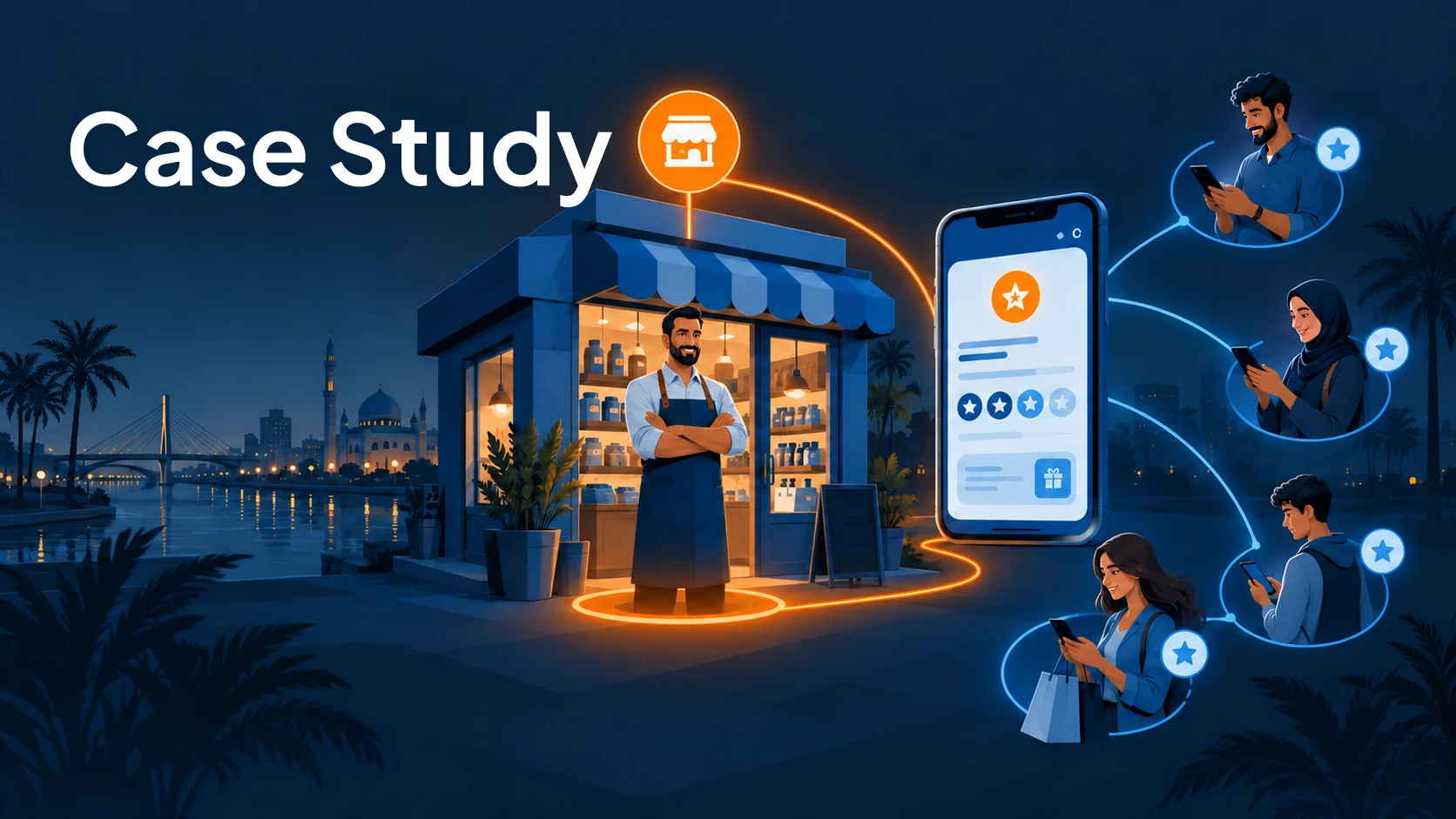
Consumers use a loyalty programme, but a business owner decides whether to subscribe and pay. That distinction shaped my marketing strategy work for the loyalty platform in Basra: how could the platform explain its value to the buyer and choose acquisition routes its small team could support?
Points and rewards matter to the consumer. A restaurant or shop owner has additional questions: what will the programme do for my business, how will my team use it, and is the value worth the subscription? Answering those questions connected audience analysis with messaging, content and sales support.
On this page
A consumer experience with a business buying decision
the loyalty platform is an Iraqi technology platform providing customer loyalty points programmes for businesses and shops. At the time of the project, its model involved annual business subscriptions alongside loyalty cards used by consumers. The initial geographical focus was Basra, with expansion considered for a later stage.
I worked on its B2B marketing and customer acquisition strategy during May–June 2024. The business was at an early stage, building awareness and its subscriber base with a limited marketing budget and constraints on the team’s time and operating resources.
I reviewed the business model, target audience and competitive context, including a SWOT analysis. Alternatives included other technology solutions and loyalty schemes managed by shops themselves. The idea of points and rewards therefore needed a clear explanation of why a business owner would choose this service.
Identifying the buyer clarified the message
The central marketing question was what would make a business owner interested in learning about the programme and evaluating a subscription. This meant connecting features with commercial needs such as repeat purchasing, customer understanding and managing customer relationships.
Those needs guide the value proposition; they do not establish a guaranteed sales increase. A prospective buyer still needs to understand how the programme works, whether it fits the business, what it requires and how to assess its contribution.
I developed an illustrative buyer persona around a restaurant owner to make needs, concerns and questions more concrete. This was a planning example. I also mapped the journey through awareness, enquiry, subscription, use and loyalty to connect content and contact points with the owner’s decision process.

Choose acquisition routes the team can support
The proposed approach combined direct business outreach with content and digital advertising. Each route had a purpose: visits and conversations could explain the service and surface questions, while content and advertising could introduce the programme and generate enquiries.
I recommended direct sales and visits to local businesses as one acquisition route. For a B2B service, a conversation with the decision-maker creates an opportunity to explore fit and address objections. The recommendation also needed to be considered against the team’s capacity for visits and follow-up. Execution time belongs in channel selection alongside the advertising budget.
For the digital activity, I prepared an initial approach to campaign objectives and budget allocation, connecting content and messaging with the objective of acquiring subscribing businesses. Reach and engagement can support awareness, but the assessment should extend to enquiry quality, sales opportunities and subscriptions.
After the strategy handover, the work continued with research into local business records to support direct outreach. The broader research covered approximately 1,100 business records. These provided material for prospect research and targeting; business fit, contact accuracy and interest still needed assessment through outreach.

Content and sales need a shared explanation of value
Sales preparation formed part of the strategy support. I developed guidance and anticipated questions about how the programme works, pricing, customisation, integration, training and support. The aim was to help a representative understand the service and relate it to the buyer’s needs, rather than rely on a memorised opening.
A restaurant owner’s question about ease of use calls for an explanation of implementation needs and support. A question about commercial value calls for an explanation of how to assess the programme’s usefulness. Recognising the difference helps the representative respond to the actual concern.
On the content side, I developed messaging and editorial direction with post ideas, alongside a review of visual direction and possible alternatives. Exploratory design examples compared two visual approaches to support that evaluation.
What the loyalty platform team received
I delivered a 56-page marketing and content plan, accompanied by tools to connect strategic choices with execution and monitoring:
- Audience and sector priorities with proposed acquisition routes.
- An illustrative buyer persona and customer journey map.
- Sales guidance, anticipated questions and objections.
- Content and messaging direction with an initial advertising approach.
- A framework of eight performance indicators, including customer acquisition cost, marketing and sales qualified leads, and customer retention.
Follow-up discussions addressed the indicators, recommendations and execution challenges. The deliverables gave the team a basis for prioritising, testing channels and assessing the response, while distinguishing research records, enquiries, sales opportunities and paying subscribers.
Start with the decision you want to help the buyer make
When selling to businesses, identify who decides and pays, then establish what that person needs to understand before buying. Use those questions to shape the message, contact point and follow-up. A channel can reach many people; the business still needs to know whether it reached the decision-maker and communicated value worth considering.
With limited resources, a useful strategy connects ambition with the team’s capacity to reach, explain, follow up and measure. That connection brought the different parts of my work for the loyalty platform together.
For related practical guidance, read how to build a marketing strategy for a small business and how to review your marketing before increasing your budget.
Need to reach the right decision-maker for your service? Tell me about your business.