

You can run a well-made campaign for a relevant audience and still receive a weaker response than expected. Customers may have less spending room, their needs may have changed, or a policy decision may have affected the cost of the product itself.
If you look only at the advertising, you can spend months changing the message while missing an important change outside the business.
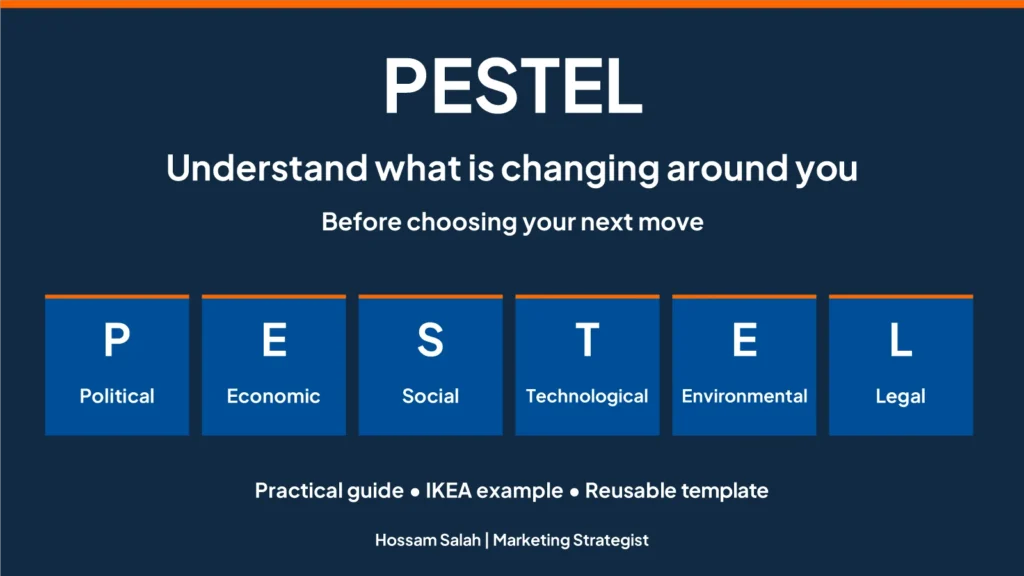
PESTEL analysis examines six groups of external factors: political, economic, social, technological, environmental and legal. It helps you identify what is changing, how it could affect the business, and which decision deserves attention.
On this page
What is PESTEL analysis? Is it the same as PESTLE?
PESTEL and PESTLE use the same six categories, with the final two letters in a different order. PEST is the four-category version covering political, economic, social and technological factors.
The framework examines the wider external environment. It does not assess your team’s skills or replace customer and competitor research. CIPD’s PESTLE factsheet explains its role in understanding the conditions in which organisations operate.
The six PESTEL factors, explained simply
| Factor | What to examine | A useful decision question |
|---|---|---|
| P — Political | Trade policy, stability and government spending priorities | Could a policy change affect sourcing? |
| E — Economic | Inflation, exchange rates, financing costs and spending power | Can customers still buy in the same way? |
| S — Social | Lifestyles, household composition, habits and priorities | Has the use of the product or reason for buying changed? |
| T — Technological | New capabilities and changes in search, purchasing and service | Could a new experience help customers choose or try? |
| E — Environmental | Climate, resources, energy and waste | Do material availability or product impacts need attention? |
| L — Legal | Rules affecting products, advertising, data and employment | Do the offer or data practices need to change? |
Categories can overlap. A government decision can have economic consequences and legal requirements. Record the connection without turning one development into three separate priorities.

A real example: reading PESTEL through IKEA
IKEA sells furniture and home solutions, but product design is only part of the picture. Sourcing costs, life at home and the ability to visualise a purchase also matter.
The examples below connect public information about IKEA and its environment with useful business questions. Dates and markets are identified where relevant; this is an educational reading of that information.
1. Political: trade policy can reach the product’s cost
Inter IKEA Group’s FY25 summary connected uncertainty around US tariffs with higher sourcing costs in the second half of the financial year. See the Inter IKEA Group FY25 financial summary.
The marketing question goes beyond the next advertisement. Is the price promise still sustainable at the new sourcing cost? Should the promoted range change before committing to the campaign?
2. Economic: spending power changes the comparison
The IKEA Life at Home Report 2026 places financial concerns among the pressures affecting life at home. A household with less spending room may postpone a complete replacement or seek a lower-cost solution to a specific need.
That suggests a question for the offer: should the message emphasise a focused improvement rather than furnishing an entire home? Investigate the relevant segment before selecting a discount or bundle.
3. Social: people use their homes differently
The same report examines needs across life transitions, including starting independent life, moving home and retirement. One household’s priorities will not automatically fit someone furnishing their first personal space.
Could content and offers be organised around situations rather than one generic audience? Examples include setting up a new space, adapting an existing corner or making room for activities. Use customer research to choose the segment rather than relying on age alone.
4. Technological: visualisation can become part of the buying experience
In June 2022, Ingka Group launched IKEA Kreativ, a digital experience helping customers visualise furnishings in their living spaces on computers and smartphones.
The external factor is the development of digital visualisation technology. The tool is the company’s response. For your business, identify where customers hesitate: could a demonstration, preview or simpler tool reduce that uncertainty without copying IKEA’s investment scale?
5. Environmental: materials have a source and an afterlife
Wood is central to furniture. IKEA’s wood sourcing page describes responsible sourcing and recycled wood in its business. The environmental question concerns resource protection and its implications for supply.
That raises questions about materials, product lifespan and reuse. If marketing will discuss sustainability, what specific information can customers assess instead of a broad “eco-friendly” label?
6. Legal: environmental priorities can become specific requirements
EU deforestation-free product rules cover wood and certain products made from it. The Council of the European Union explains the scope and sourcing evidence requirements.
Forest protection is an environmental factor; rules governing products in a particular market are a legal factor. Before entering that market or making sourcing claims, the relevant specialists need to establish which requirements and documentation apply to the product.
How to conduct a PESTEL analysis
Start with a decision
Define the choice: entering a country, launching a service, reviewing a price or changing how you sell. Set the market, segment and planning horizon. A factor that matters in one country may have little impact in another.
Record the development, evidence and effect
“Inflation” is a topic, not an analysis. Identify the cost or buying behaviour affected, the source and its date. Use relevant official data, market research, customer feedback and your own business data to understand the impact.
“Customers will choose a cheaper alternative” remains an assumption, even when prices rise. Check actual enquiries, objections and orders to understand the response.
Prioritise the factors
Start with high-impact developments that are approaching and well-supported. If an important factor has weak evidence, make research the next step. A distant issue outside your scope should not take the same resources.
Assign an action, owner and review
If costs pressure the price, test an appropriate offer or range while tracking margin and customer response. If a new need is emerging, start with research or a limited experiment. If market entry depends on a legal requirement, resolve that before launching the offer.

PESTEL vs SWOT: what is the difference?
| Comparison | PESTEL | SWOT |
|---|---|---|
| Scope | The wider external environment | Internal capabilities and limitations, plus external opportunities and threats |
| Question | What is changing around us? | How are we positioned to respond? |
| Example | Developing furniture visualisation technology | An opportunity to improve customer choice, alongside the ability or constraints to deliver it |
| Output | Relevant external developments and their implications | Priorities connecting the business with its opportunities and threats |
Use PESTEL to broaden your view, then carry the most relevant findings into the opportunities or threats in your SWOT analysis. Add internal strengths and weaknesses to understand your options. Transfer what changes the decision rather than copying every note.
PESTEL also does not replace competitor analysis. Direct competitors, their offers and buying experiences require a closer comparison of market alternatives.
A ready-to-use PESTEL template
Copy this into your working document. Repeat the factor section as needed; the six categories do not need an equal number of entries.
Decision under review: …
Country and segment: …
Planning horizon and analysis date: …Factor: political / economic / social / technological / environmental / legal
Specific development: …
Source and date: …
Potential impact on customers, cost or delivery: …
Evidence confidence: strong / moderate / weak
Timing: near / medium / long term
Priority and rationale: …What still needs checking: …
Next action: …
Owner and resources: …
Review date and measure: …
Common PESTEL mistakes
- Collecting unrelated news: an important global development is not automatically material to your decision.
- Mixing internal and external: a team skills gap is internal; the emergence of a technology is external.
- Calling a response a factor: launching an app is a decision. Examine the technology or behaviour that could make it useful.
- Copying a large company’s analysis: learn the method, then investigate your own market and customers.
- Stopping at categories: specify what the information will change and when to review it.
PESTEL analysis questions
Can a small business use PESTEL?
Yes. Match the depth to the decision and resources. You might prioritise two influential factors after scanning all six categories for anything material.
Must PESTEL come before SWOT?
Not every time. Start with it when the external environment needs investigation. If that view is current and the decision is narrow, use the relevant findings directly in SWOT.
How often should it be updated?
Review it before significant market entry or an important offer launch, and revisit sensitive factors when a material change appears. Choose a rhythm that fits the decision rather than one universal schedule.
Move from market context to the next decision
Choose a current decision and write down the two most relevant external developments. Attach evidence, describe the likely effect and identify the next action. If the analysis changes no question or choice, reconsider whether the information is useful.
Once you understand the environment and your position, choose the direction and organise delivery. Continue with marketing strategy vs marketing plan, then the 90-day marketing plan template.