

You may have used artificial intelligence today before opening a chatbot. Your email filtered a suspicious message, your phone grouped similar photos, or a platform suggested something you might want to watch. Later, you asked an assistant to draft a message.
These applications can all involve AI, but they perform different jobs. Understanding those differences makes it easier to choose a useful application instead of expecting every tool to solve every problem.
Artificial intelligence is a field concerned with systems that perform tasks such as recognising patterns, processing language, making predictions and generating content. What a system can do depends on its design, training and the context in which it is used.
On this page
What does artificial intelligence mean in practice?
Imagine sorting thousands of emails into normal messages and spam. One approach uses manually written rules. Another learns patterns from examples and applies them to a new message.
The second approach illustrates machine learning. You do not need a separate handwritten rule for every possible email, but an important message can still be misclassified. A useful system also needs a way to review and correct the result.
IBM’s introduction to AI describes capabilities including learning and problem-solving. When evaluating a product, translate that broad description into a specific question: what task is this particular system intended to perform?AI, machine learning, deep learning and generative AI
These terms describe connected ideas at different levels. They are not four unrelated products competing for the same role.
| Term | Core idea | Simple example |
|---|---|---|
| Artificial intelligence | The wider field of systems performing intelligent tasks | Recognising objects or supporting a decision |
| Machine learning | Learning patterns from training data | Forecasting demand using historical data |
| Deep learning | Machine learning using multilayer neural networks | Models that process images or speech |
| Generative AI | Producing content in response to a request | A draft, image or piece of code |
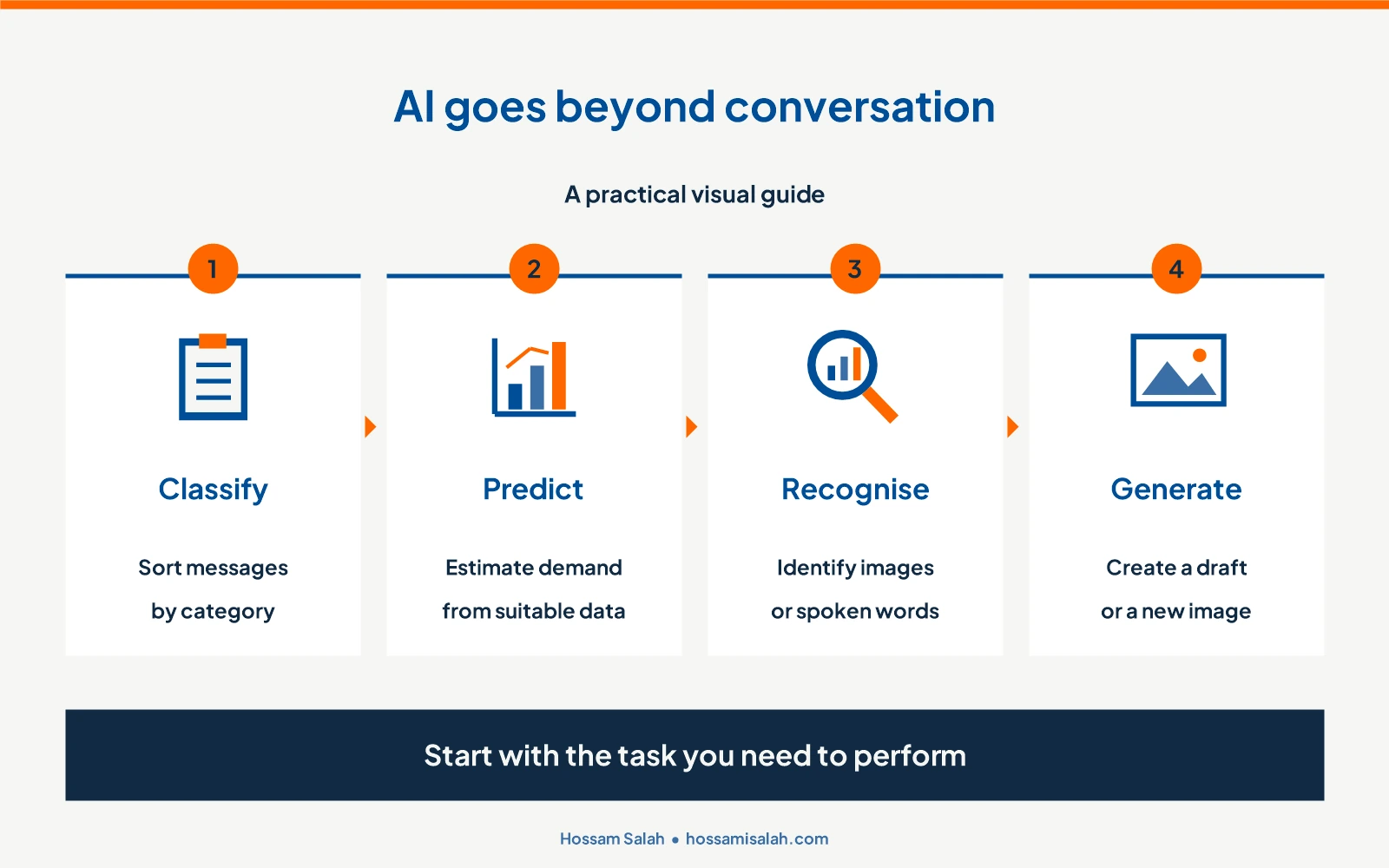
The useful starting distinction is between a system that classifies or predicts and one that generates content. A product can combine both. IBM provides separate introductions to machine learning and generative AI if you want the technical detail.
What are the different types of AI?
The classification depends on the question. Categories based on application include prediction, vision, language processing and content generation. Categories based on breadth of capability include narrow AI, artificial general intelligence and superintelligence.
Narrow AI operates within a defined scope. General intelligence describes a broadly transferable capability across tasks and situations; superintelligence describes capabilities exceeding human intelligence. These are research concepts. A conversational product answering many kinds of questions does not, by itself, establish that it has achieved general intelligence. See IBM’s discussion of AI types for the distinction.
Where can AI be useful?
For learning, it can help explain a concept before you attempt a problem yourself. In customer service, it can help organise enquiries and prepare draft responses. In operations, a suitable model can support a demand forecast.
For content and design, it can help develop an initial outline or visual direction. You then check the information, message and brand requirements. In analysis, it can suggest questions to investigate, provided the inputs and calculations are sound.
Choose an application around a real problem. If essential information is missing, producing a longer report does not fill the gap.
A simple example: turning customer questions into useful content
Consider a customer service team receiving repeated questions about sizing, product care and returns. The team can remove personal information, collect the questions and ask an assistant to group them by subject.
After reviewing the categories, the team chooses which questions deserve an explanation. A text tool can propose a post outline. The team supplies verified product details and the actual returns policy, then checks that the draft makes no unsupported promises.
The tool helps organise material and accelerate a draft. Deciding what to communicate still requires an understanding of the business and its customers. That is also a useful starting point for a content marketing strategy.
Why can a convincing answer still be wrong?
Generated text can contain an inaccurate fact, combine unrelated sources or include a link that does not support the accompanying claim. Confidence of presentation is not sufficient evidence.
If you are comparing prices, open the pricing pages. If you are analysing a table, verify the units, period and totals. If you generate a product image, compare its details with the real product before using it to sell.
Start with work you can judge, such as organising your own notes or improving an existing draft. Consequential decisions need an appropriately qualified reviewer before the output is adopted.
How to start without collecting too many tools
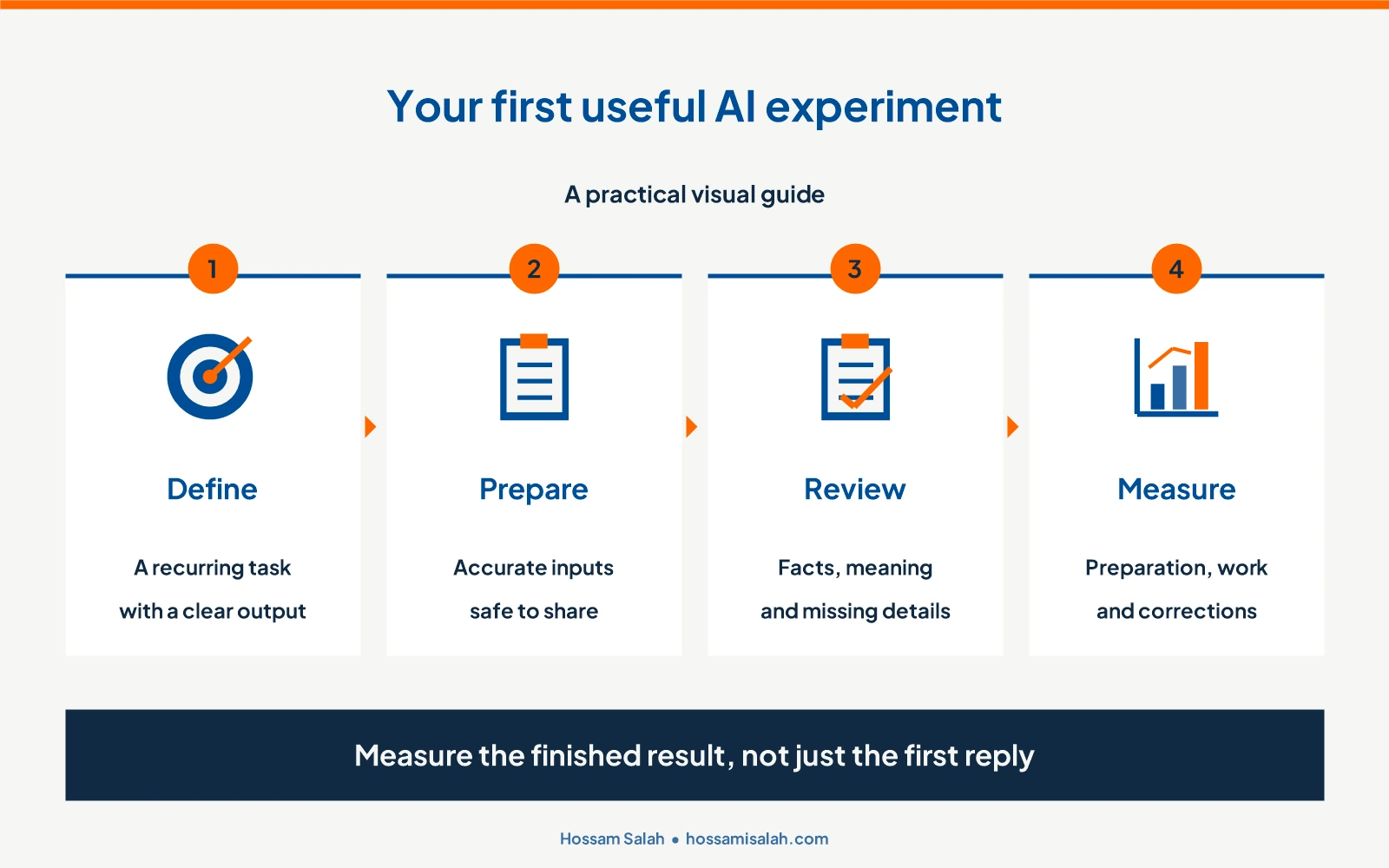
Pick a recurring task and define an acceptable result. For meeting notes, that might mean an accurate list of decisions, owners and deadlines. Use non-sensitive sample notes and check that nothing important was changed or invented.
Measure the whole process: preparing the inputs, generating the result and correcting it. A faster first draft is only useful if the final deliverable also becomes easier to complete.
Next, explore the AI tools selection guide, or try a specific workflow in the ChatGPT beginner’s guide.
Frequently asked questions
Is AI the same as ChatGPT?
ChatGPT is one product that uses AI. The field also includes systems for forecasting, classification, images, speech and other tasks.
Is every automated process AI?
No. An order-confirmation email can be triggered by a fixed rule. An automated action does not necessarily involve an AI model.
Do I need to learn programming?
Many applications accept ordinary language. Programming becomes useful when building systems and integrations, but it is not a requirement for your first experiments.
Can AI help me earn an income?
It can support learning and production, but clients pay for useful deliverables, quality and reliability. Start with work you can review and deliver, then build examples that demonstrate that ability.
Try one useful task today
Choose one task, define what you need and try the tool. Correct the missing context, review the output and compare the complete process with your usual approach. A small experiment will teach you more about your needs than collecting an unused list of products.